
Rescue in the Surf
This was not a demo or part of a class and it was not a ‘life or death’ sort of situation. My reason for telling the story is for learning purposes. It was a chance for me to think through what I did and why, and to provide some insights as to my decisions/process for others to use as part of their training/education.
The setting
The paddler, while part of a group there for the weekend, was on his own (and yes, something I have done too). He was generally safe out there and had some experience. Prior, he exited and swam back in several times.
I was there with 2 others for an impromptu surf lesson only because I cancelled my planned trip for the morning as I didn’t want to lead 2 less experienced paddlers through the surf and down the coast in dense fog.
This time he was a bit further out when we went over. He got over the cockpit to control the kayak back to the beach – exactly as we teach – but after a few minutes watching him from the beach, it was clear he was not moving. He was enough of an sea anchor and just on the edge of the small rip on a low energy day.
The rescue
The initial thoughts in my head when I made the decision to launch:
- I knew he was dressed properly
- He was clearly not panicked – no visible distress from the beach
- I knew once he let go of the kayak, he’d be able to swim back on his own – and that was the plan; have him release the kayak and swim.
It didn’t play out that way.
Why the bow?
This came up in a couple of private messages and in comments after posting the original video as a Facebook and Instagram reel.
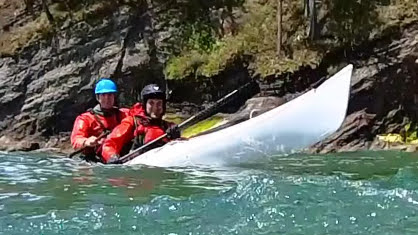
As stated, my original intent when I launched was to have him let go of the kayak, then swim back. You can hear that conversation at :44. I told him he could just swim in (probably the safest option) or grab my bow. As soon as he asked if I was going to put him on my bow, that decision was made for me. He was already thinking and heading for my bow. I could have communicated I wanted him on my stern and turned, but that would have added the risk of miscommunication, the potential for me to hit him (he was off to my side but also closer to the beach and waves limit the ability to control a kayak), and more time for the rescue
Supporting my decision was the information I had assessed prior to launching, on the way out, and when I reached him – his mental state (calm vs panicked), was he struggling, could he get on my back deck, what was most efficient – think wilderness first aid in a dynamic environment.
A note here: I offered the option of my bow rather than just telling him to swim based on experience. Not everyone will ask for help – until they absolutely need it. People seem to be quicker to take help when offered – ‘I can do it myself, but since you asked, sure’. I wanted him (as others in any rescue scenario) to know that option is there and make it clear immediately.
Better they take the help and not have needed it.
Additional thoughts on the rescue decision
- I generally prefer the stern or back deck carry. It’s usually safer for both:
- Any waves that break do so on the back of the swimmer, not their head.
- Waves don’t push the swimmer’s face into the bow.
- You have more control (generally) coming in vs the bow carry
The back deck carry does, however, require the swimmer be able to scramble onto the kayak (not everyone can and being cold and tired can make that harder for those who can). They need to stay low and balanced once on the deck and good communication is required. Not so easy.
In the class I was teaching the next day with fellow instructors, students were practicing the back deck carry. There were a couple of ‘surfs’ in so less control and a couple of capsizes…the back deck carry requires more skill in my opinion, both for the rescuer and the swimmer.
There is also the consideration of size – your sea kayak and the swimmer. The kayak I was paddling is only 14′ and low volume. That means a short back deck. With a taller or heavier swimmer, it can be hard for them to get on the back deck – as in they don’t fit! More weight will mean sinking the stern. That prevents any chance of surfing in (more control), but it can have the same effect as an anchor and the same result as what prompted me to paddle out to him initially.
There is no right or wrong
My decision was correct for me in that scenario. It might not be right the next time. It also doesn’t mean there were other options that would have worked as well -or better.
In the end, it’s about having the skills, knowledge, and experience, then adapting to a dynamic situation in a dynamic environment. No two rescues I do will ever be alike. I am making decisions in real time and constantly evaluating. All rescues are ‘fluid’. You need to be able to adapt, while staying calm and clear-headed.
Experience matters
I have taken plenty of classes and practice rescues in the conditions I paddle and teach all of the time – to the point it’s instinctual (the same way my strokes are). As busy as I am teaching, I make sure to get on as many club paddles in as many conditions as possible with as many different people as possible. This provides me the opportunity to practice rescues in real situations (when they happen), but it also allows me to observe and run scenarios in my head while on the water. The whole exercise of ‘what if’ is invaluable to me even without a real rescue.
There is no substitute for experience. Time in the seat is part of what separates good paddlers from great paddlers. Skills are honed through use – that includes both hard and soft skills. That experience is what builds confidence – the confidence to be able to adapt and sort things out in real time.
A few final thoughts
- This was a small day – low energy, 2-3′ waves, 6 second period – but small days don’t eliminate risk.
- If you are out alone – especially in coastal environments – you both need the skills AND the ability to adapt. He did what he was taught. Had he let go of the kayak sooner, he wouldn’t have needed help. Not ideal to send a kayak to the beach, but in that situation, it was not risky.
- This was the second technical/dynamic water rescue I had done in a 2 week period (both well practiced but never actually done when needed until now). These are never ‘by the book’ and require good skills, thinking and adapting in real time, and staying calm and in control. If you teach in these environments, if you are leading trips in these environments, are you sure you are capable of performing the rescues that could be needed?
COULD I have done anything different knowing how it went and what I know now? Yes.
I made a decision in the moment in a dynamic situation in a dynamic environment. There was a good ending. That’s what ultimately matters.

 2022, Robert Nissenbaum
Leave a Reply
Want to join the discussion?Feel free to contribute!